Bra: A Simple Comfort, Fit Style Guide to Finding “The One” & Online Shop
If your bra leaves red marks, your straps keep sliding, or the wires feel like they’re plotting against you, you’re not alone. A bra is one of those everyday items that should fade into the background, but when it doesn’t fit, it can ruin your whole day.
Fin a Bra Online
This UK-friendly bra guide keeps things practical and body-positive. You’ll learn how to spot a poor fit (and what to do about it), how to measure at home, which styles suit your clothes and comfort, and how to make your bras last longer.
No judgement, no fuss, just clear steps and a bit of relief for your shoulders.
What a bra should do (and signs yours does not fit)
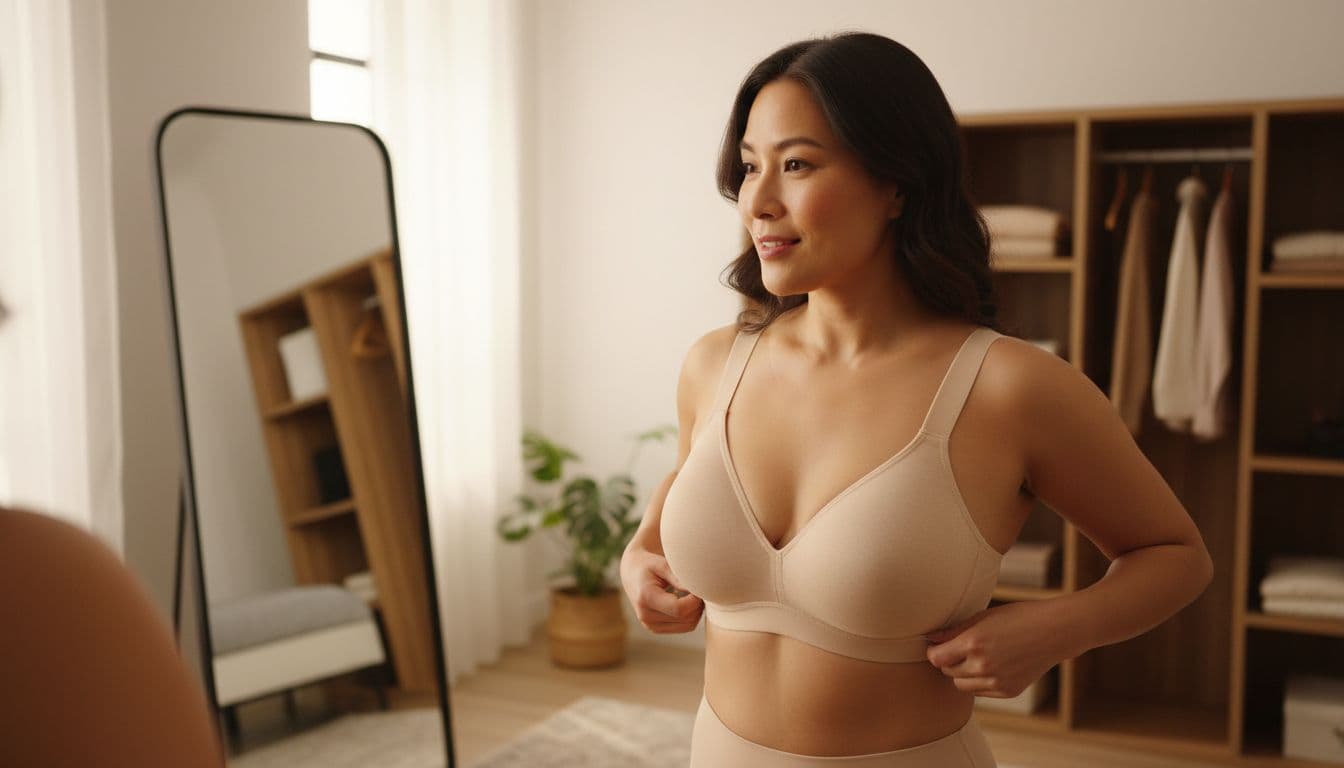 Checking bra fit in a mirror, focusing on a smooth band and supportive shape, created with AI.
A good bra does four jobs: support, comfort, (optional) shape, and confidence. That’s it. If it’s pinching, shifting, or making you constantly adjust it, something’s off.
Here’s a quick skim checklist before you shop or re-fit:
- The band feels firm and steady, it doesn’t creep up your back.
- The cups hold all breast tissue, including near the underarm.
- The straps stay put, but don’t carry all the weight.
- For wired bras, the centre gore (the panel between the cups) sits flat.
- You can breathe easily and move your arms without the bra fighting back.
If you’re thinking, “Mine does none of that,” don’t panic. Most fit issues come down to the band being too big, the cups being the wrong volume, or the shape not matching your body.
Quick fit check: band, cups, straps, and centre gore
Do this in front of a mirror with your bra on the loosest hooks.
Band
- It should sit level all the way around, and feel snug.
- You should be able to slide two fingers under it, but not pull it far off your body.
- The band should do most of the work, not the straps.
Cups
- No spilling over at the top or sides.
- No gaping or wrinkling.
- The wire (if you have one) should sit around the breast tissue, not on it.
Straps
- They should feel supportive, not painful.
- If loosening your straps makes the bra drop, the band and cups are not doing enough.
Centre gore (wired bras)
- It should sit flat against your chest.
- If it floats away, the cups are often too small, or the bra shape is wrong for you.
Common quick fixes that work more often than you’d think:
- If the band rides up, go down a band size.
- If you’re spilling out, go up a cup size (or try a more closed cup shape).
- If the wires poke, try a different style (not all wires match all ribcages).
Common bra problems and what they usually mean
Most bra annoyances have boring causes, which is good news, because boring causes are easier to fix.
ProblemWhat it often meansWhat to try nextStraps slippingBand too big, straps set too wide, sloping shouldersGo down a band, try racerback or closer-set strapsBack riding upBand too big or stretched outSmaller band, or replace if oldUnderwire pokingSize or shape mismatch, wire channel wornDifferent cup shape, check wire sits behind tissueCup wrinklingCup too big or wrong shape (too tall or too projected)Down a cup, or try a different styleOverflow (top or sides)Cup too small, centre gore not tackingUp a cup, or try a fuller-coverage cup
One extra tip that helps: do a quick “scoop and swoop”. Lean forward slightly, guide breast tissue into the cups from the sides, then settle the wire in the crease under the breast. Many “wrong size” moments are partly “not in the cup properly” moments.
How to measure bra size at home (UK sizing)
Bra sizing varies by brand and style, so treat measurements as a strong starting point, not a final verdict. A soft tape measure and a non-padded bra (or no bra if that’s easier) will get you close enough to shop smarter.
Try to measure when you’re relaxed, not right after a workout. If you’re between sizes, write both down.
Step-by-step: measure your band and bust, then find a starting size
1) Measure your underbust for band size
- Wrap the tape measure around your ribcage, right under your bust.
- Keep it snug and level, exhale normally.
- Note the number in inches. In UK sizing, band sizes are usually even numbers (28, 30, 32, 34, and so on), so round to the nearest even size that feels realistic.
2) Measure your bust for cup size
- Wrap the tape around the fullest part of your bust, usually across the nipples.
- Keep it level and not tight, the tape should rest against you.
- Note the number in inches.
3) Work out cup volume from the difference In plain terms, the bigger the difference between bust and underbust, the larger the cup. As a rough guide, each extra inch tends to move you up a cup letter (A, B, C, D, DD, E, F and so on). UK cup lettering often includes DD, then E, F, FF, G, and so on.
Don’t get stuck on the letter. A cup size only means something with a band size. A 30E and a 38E are not the same volume.
4) Try it on like it matters Your “starting size” is the size you try first, then you adjust based on fit checks. If the band feels great but the cups don’t, don’t change everything at once.
Sister sizes and why your size can change across styles
Sister sizes are different band sizes with a similar cup volume. They’re useful when one part fits and the other doesn’t.
A simple way to think about it:
- If the band feels too tight but the cups feel right, go up a band and down a cup.
- If the band feels too loose but the cups feel right, go down a band and up a cup.
Examples (UK sizing):
- 34E sister sizes: 32F and 36DD
- 32D sister sizes: 30DD and 34C
Your size can also shift over time, even if your weight doesn’t change much. Hormonal cycles, exercise routines, pregnancy and breastfeeding, stress, and age can all change breast shape and fullness. A re-check every 6 to 12 monthssaves a lot of frustration.
Bra styles explained: choose the right bra for your outfit and comfort
Think of bra styles like shoes. You can force one pair to do everything, but it’s rarely comfortable. The right style depends on neckline, fabric, movement, and how much lift you want (or don’t want).
Breast shape matters as much as size. Two people can measure the same and still need different cups, wires, and coverage.
Everyday bras: T-shirt, balcony, plunge, and full cup
T-shirt bras These are smooth, often lightly moulded, and designed to disappear under knit tops. They suit days when you want a clean line and minimal fuss. If you get gaping at the top, try a less moulded cup or a different shape, not just a smaller size.
Balcony bras Balcony (or balconette) bras have more open cups and lift from underneath. They work well with wider necklines and can give a rounded shape without full coverage. If you’re fuller on top, check for cutting in at the edge.
Plunge bras Plunge bras have a lower centre gore, making them great for V-necks and lower fronts. They can suit close-set breasts because there’s less fabric in the middle. If the gore still won’t sit flat, you may need more cup depth.
Full-cup bras Full-cup styles offer more coverage and can feel very secure for everyday wear. They often suit softer tissue or anyone who wants fewer wardrobe malfunctions when bending, lifting, or chasing a bus.
Support-focused bras: sports bras, minimisers, and high-impact options
If you only own one sports bra and it’s “fine”, you might be underestimating how much easier exercise can feel with proper support.
Sports bras usually fall into two types:
Compression
- Presses the breasts closer to the chest.
- Often feels simpler and can suit lower-impact activity.
- Can feel restrictive if you want separation.
Encapsulation
- Supports each breast separately (like a normal bra, but stronger).
- Usually better for high-impact workouts.
- Often includes structured cups and firmer bands.
For high-impact support, look for a firm band, wider straps, and bounce control that doesn’t rely on tightening the straps to the limit. Racerback options can help keep straps in place, especially if your shoulders are narrow.
Minimiser bras are different. They don’t shrink your body, they redistribute breast tissue across the chest for a flatter look under shirts. If you want that effect, prioritise comfort and breathability. A minimiser that feels like armour won’t be a daily favourite.
Special solutions: strapless, adhesive, bralettes, and maternity bras
Strapless bras A good strapless bra is all about the band. If the band is too loose, it will slide, no matter how fancy the cups are. Look for silicone grip, supportive side panels, and consider a longline shape for extra hold. If you’re between bands, the smaller band usually behaves better here.
Adhesive bras Useful for tricky outfits, but not a full support option for most people. They can work for short wear and lighter support needs. Clean, dry skin helps them stick better, and they don’t love heat or sweat.
Bralettes Bralettes are comfort-first and can still look polished under a blazer or chunky knit. They’re great for light support, lounging, and days when underwire feels like too much. If you want more lift, look for wider underbands and more structured fabrics.
Maternity and nursing bras Your size can change quickly in pregnancy and breastfeeding, so flexibility matters. Stretchy cups, easy nursing clips, and soft seams make a difference. Many people find it easier to buy one supportive option for daytime and a softer sleep bra for nights.
AI outfit ideas assistant: office outfits that stay bra-friendly
A smart direction for the office is clean layers, soft fabrics, and necklines that sit neatly over your bra, with comfort-first support you can wear all day.
- Polished Neutral Office Classic
- Top(s): Soft V-neck blouse with a modest neckline
- Bottom(s): Tailored ankle-length trousers, mid-rise
- Layers: Single-breasted blazer with a bit of stretch
- Footwear: Loafers (comfortable for commuting)
- Accessories: Structured tote, small hoop earrings, simple watch
- Key colour palette: All neutrals (cream, camel, black)
- Fit notes: Tailored but not tight through the bust, bra-friendly only, avoid sheer fabric
- Why it works: It looks sharp, but the outfit doesn’t pull across the chest, which keeps your bra lines smoother and your band in place
- Comfort-First Smart Knit Set
- Top(s): Fine-knit crew-neck jumper (not clingy)
- Bottom(s): Matching knit skirt or wide-leg knit trousers
- Layers: Long wool coat for winter layering
- Footwear: Loafers or sleek ankle boots if it’s wet outside
- Accessories: Pendant necklace worn over the knit, leather belt bag worn crossbody
- Key colour palette: Soft neutrals (stone, grey, navy)
- Fit notes: Relaxed but tidy, works well with a smooth T-shirt bra to avoid texture showing
- Why it works: Knitwear can show bumps, so a smooth bra and a forgiving fit keep you comfortable at your desk
- Structured Shirt and Midi Skirt (Bigger Bust-Friendly)
- Top(s): Crisp button-up shirt with bust darts or stretch panels
- Bottom(s): A-line midi skirt that skims the hips
- Layers: Lightweight cardigan for temperature swings
- Footwear: Loafers (or block-heel loafers if you want height)
- Accessories: Stud earrings, slim bracelet, hair clip for a neat finish
- Key colour palette: Black-focused with one lighter piece (white or pale blue)
- Fit notes: Choose a fuller-coverage bra if buttons gape, and avoid stiff shirts with no give
- Why it works: The skirt balances the silhouette, and the right bra helps the shirt sit flat without pulling
How to shop smarter for a bra in the UK (comfort, quality, and care)
A bra doesn’t need to be expensive to be good, but it does need to be well made in the parts that matter. If you’ve ever owned a bra that felt perfect for two weeks, then went limp, you’ve seen what weak elastic can do.
Comfort-first is a valid goal. Support should feel secure, not punishing.
What to look for in quality: fabric, construction, and adjustability
A few details can tell you a lot before you even try it on:
- A wider band often feels more stable and can reduce back digging.
- Firm elastic with good recovery (it springs back) helps the bra keep its shape.
- Secure hook-and-eye closures, extra rows can help you fine-tune fit.
- Strap width that matches your needs, wider straps can feel kinder for heavier busts.
- Soft wire channelling (the fabric around the wire) reduces rubbing and poking.
- Smooth seams if you want invisibility under thin tops, seamed cups can be better for shape and lift.
If you hate underwire, you’re not “doing bras wrong”. Non-wired bras can still be supportive, but the fit of the band becomes even more important.
How to make bras last: washing, drying, rotation, and when to replace
Bras last longer when you treat them like the stretchy, hardworking items they are.
Simple care rules:
- Wash on a cool, gentle cycle.
- Use a laundry bag to protect hooks and straps.
- Skip the tumble dryer, heat breaks down elastic fast.
- Reshape cups while damp, then air dry.
- Rotate bras, wearing the same one daily wears it out quickly.
Signs it’s time to replace:
- The band feels loose on the tightest hook.
- Straps are fully tightened but still slip.
- Wires poke or twist, or the centre gore won’t sit flat anymore.
- Support is gone, even after adjusting.
If you’re buying a new bra, start it on the loosest hook. That gives you room to tighten as the band relaxes with wear.
Conclusion
A bra that fits well shouldn’t feel like a constant project. Start with a quick fit check, use at-home measurements as a guide, then choose a style that suits your clothes and your comfort. After that, good care helps your bra keep its fit, so you’re not back at square one in a month.
Do your fit check today, even if it’s just 60 seconds in the mirror. If anything feels off, re-measure and try one sister size, you might be closer than you think.
Shop For Bras Online
Explore More Women’s Clothes, Fashion and Accessories
Womens Clothes Dresses Vintage Style Lingerie Swimwear Shoes Trainers
Maternity Clothes Baby Clothes
Jewellery Perfume Make Up Handbags Accessories
Discover Men’s Clothes, Fashion and Accessories
Men’s Clothing Men’s Outdoor Footwear Sneakers Mens Underwear Men’s Swimwear
Men’s Watches Men’s Jewellery Bags Accessories Aftershave
–
Explore our Buyers Guides & Money Saving Tips
For a list of our main buyers guides use the drop-down menu at the top of the page.
https://comparepriceswebsite.co.uk/index.php/2026/01/04/bra/


Comments
Post a Comment