Breakdown Cover for Older Cars: What to Look For, Our Guide & Get Cover Online
When your car’s manufacturer warranty ends, driving can start to feel a bit like walking a tightrope without a net. Most older cars are still dependable, but when something does go wrong, it usually happens at the worst time.
Breakdown Cover for Older Cars
That’s where breakdown cover comes in. It’s not about paying for repairs like a warranty, it’s about getting help when your car won’t start, won’t move, or isn’t safe to drive.
This guide explains what to check in a UK breakdown policy, the exclusions that catch people out, and how to choose the right level of cover without paying for extras you won’t use.
Do you still need breakdown cover when your car is older?
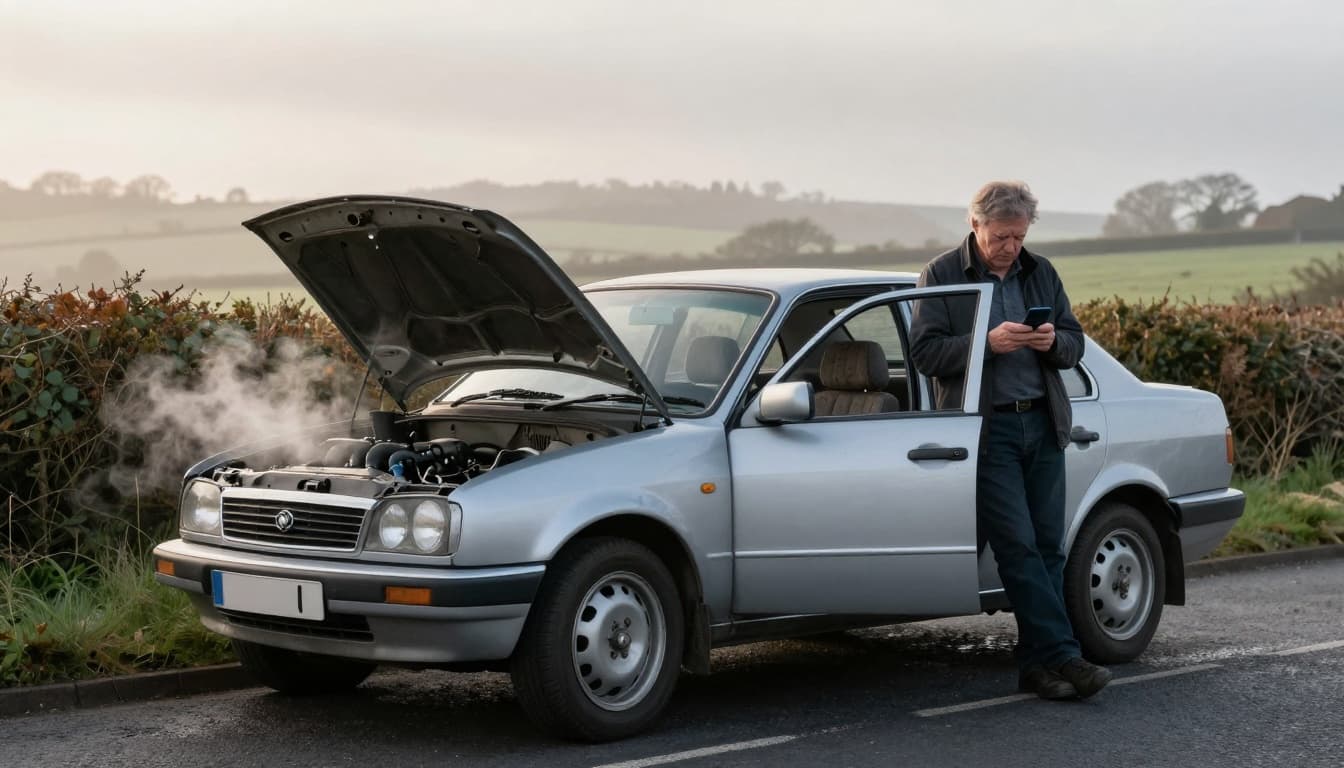 An older car broken down at the roadside, created with AI.
Breakdown cover tends to matter more as cars age because small weak points add up. A tired battery, a sticky starter motor, or an old coolant hose can turn a normal day into a long wait on the hard shoulder.
It’s usually worth having cover if you recognise any of these:
- You do high mileage or motorway commuting.
- You drive in rural areas where recovery can take longer.
- The car is your family workhorse (school runs, shopping, weekend trips).
- Your MOT history shows repeat advisories (tyres, brakes, corrosion).
- You can’t easily handle the surprise cost of recovery and getting home.
It can be less urgent if the car is a second vehicle, mostly used for short local trips, and you’ve got other options if it won’t start. Even then, think about safety. A breakdown at home is annoying, a breakdown on a dark road in winter is something else entirely.
Common causes of breakdowns in older cars (and what cover can actually help with)
Older cars don’t just “give up”. They often fail in boring, fixable ways, like a phone battery that won’t hold charge anymore.
Common breakdown triggers include:
- Flat or weak battery (often fixed at the roadside, sometimes needs a replacement).
- Puncture (may be repaired roadside, depends on tyre condition and kit).
- Overheating (usually needs recovery if there’s coolant loss or engine risk).
- Starter motor or alternator faults (often recovery, the car may not restart).
- Fuel issues (misfuel, blocked filter, running out can vary by policy).
- Electrical faults (could be a quick fix, could need a tow).
Roadside assistance is best for problems that can be made safe and running again quickly. If a part has failed, recovery to a garage is the usual outcome.
Breakdown cover vs warranty and service plan: what changes after the warranty ends
A warranty usually helps with the cost of parts and labour for covered faults. Breakdown cover usually doesn’t. Breakdown cover is about getting you moving, or getting the car to a safe place.
Think of it as three separate things:
- Help at the roadside (diagnose, attempt a fix).
- Towing or recovery (move the car to a garage or destination).
- Repair costs (normally paid by you, unless you have a separate warranty).
A good service history reduces the chances of a breakdown, but it doesn’t replace recovery support. Even well-maintained cars get punctures, flat batteries, and random electrical gremlins.
What to look for in breakdown cover for older cars
Policy wording matters more than the headline price. Older cars can be hit harder by age rules, wear and tear exclusions, and limits on call-outs. Before you buy, check where you’re covered, how far you’ll be taken, and what happens if the car can’t be fixed quickly.
Cover level: roadside, at-home, recovery, onward travel, and European driving
These terms get thrown around a lot, but they’re simple once you match them to real life.
Cover typeWhat it usually meansBest forRoadside assistanceHelp if you break down away from homeMost driversAt-home coverHelp if the car won’t start on your drive or nearbyOlder cars, short-trip driversRecoveryTowing beyond the “local” area, up to a set limitLong trips, motorway usersOnward travelHelp you continue your journey (train, hire car, hotel)Commuters, familiesEuropean coverAssistance abroad, often with extra conditionsDriving holidays
If your car lives outside and you do lots of cold starts, at-home cover can be the difference between making work and waiting for a jump start you can’t get.
Vehicle eligibility rules: age limits, mileage limits, and modification rules
Some providers cap cover at a maximum vehicle age or mileage. Others accept older cars but limit what they’ll do, or charge more. Don’t assume your car is eligible just because you can click “buy”.
Also check whether the policy treats these differently:
- Modified cars (engine changes, suspension, remaps).
- Vans or vehicles used for business or deliveries.
- Classic cars, imported cars, or unusual fuel types.
If the car isn’t accepted, you don’t want to find out after you’ve paid.
Key exclusions to check (the bits that usually cause claim refusals)
Most claim refusals come down to exclusions, not bad luck. For older cars, the most common sticking points include:
Pre-existing faults: If a warning light has been on for weeks, you might not be covered for the resulting breakdown.
Wear and tear: Many policies won’t cover failures seen as gradual deterioration.
Tyres and batteries: Some cover only includes a jump start or tyre change, not a replacement.
Running out of fuel: Often covered as a one-off, sometimes excluded or limited.
Repeat call-outs: If the same issue keeps happening, help may be restricted until it’s repaired.
Unsafe or illegal vehicles: No MOT, bald tyres, or serious defects can cause problems.
Reading the exclusions sounds dull, but it’s cheaper than a refused call-out.
Call-out limits, distance limits, and where the car will be taken
Check the limits that shape what you actually get:
- Call-outs per year: Some policies cap you at a small number.
- Tow mileage: “Recovery included” may still have a miles limit.
- Destination rules: You might be taken to the nearest suitable garage, not your preferred one.
Also look for what happens if the car needs to be stored. Storage fees can stack up quickly if a garage can’t take it, or parts aren’t available for a few days.
Service standards that matter: response times, 24/7 support, and what happens at busy times
In winter, during rush hour, or after a big storm, waits can stretch. Check whether the helpline is 24/7, how updates are given, and whether response times change at peak periods.
If you often drive in remote areas, good communication matters almost as much as speed. Knowing where help is, and when it’s likely to arrive, takes the edge off.
How to choose the right policy and avoid paying for cover you do not need
The best policy isn’t the most expensive one. It’s the one that fits your routine and reduces the hassle you can’t afford, like missing work, getting stranded with kids, or paying for a long tow.
Match the cover to your driving pattern and risk level
A city runabout that rarely leaves town might only need at-home plus roadside. A motorway commuter is better protected with recovery and onward travel.
Think about practical risk, not just mileage:
- Parking on a steep drive can strain a weak battery.
- Short trips in winter drain batteries faster.
- A car used daily has more chances to fail at awkward moments.
Ways to cut the cost without cutting the protection
You can often spend less without leaving yourself exposed:
- Choose the cover levels you’ll use, skip European cover if you won’t drive abroad.
- Pay annually if it works out cheaper than monthly.
- Keep your car maintained to avoid repeat call-outs.
- Compare like-for-like, look at call-out limits and tow miles, not just price.
Cheap cover that won’t recover you far enough can cost more in the moment you need it.
Questions to ask before you buy (quick pre-purchase checklist)
Use these to sanity check any policy:
- Is my car eligible by age and mileage?
- Is at-home cover included or extra?
- How many call-outs do I get each year?
- Is there a tow mile limit, and what is it?
- Do you take me to the nearest garage, or a garage of my choice?
- What help is included for batteries and tyres?
- What counts as a pre-existing fault?
- What proof do I need if I make a claim?
Conclusion
Once your warranty has expired, breakdown cover becomes less about perks and more about reducing disruption. The right policy fits where you drive, where the car is parked, and how hard it would be to lose a day to a breakdown.
Before you renew or switch, read the exclusions, confirm eligibility, and compare the details that matter most, like recovery distance and onward travel. Review your cover now, not when you’re stuck at the roadside, and keep up basic maintenance to lower the odds of needing it at all.
Breakdown Cover for Older Cars
Shop for More with Our Verified UK Insurance providers:
Home Emergency Cover Home Appliance Cover– Income Protection insurance
Travel Insurance – Gadget Insurance – Phone Insurance – Caravan Insurance – Cycle Insurance – E-Bike Insurance
Car Finance – Car Breakdown Cover – Van Breakdown Cover – Motorbike Breakdown Cover
–
Explore our Buyers Guides with Money Saving Tips
For a list of our main buyers guides use the drop-down menu at the top of the page. Topics related to this article are:
Laptop Insurance Buyers Guides
Gadget Insurance Buyers Guides
Tennant’s Insurance Buyers Guide
Landlords Insurance Buyers Guide
Home Emergency Cover Buyers Guide
Travel Insurance Buyers Guides
Car Breakdown Cover Buyers Guide
–
Explore Our Blog Categories for Expert Buying Advice
https://comparepriceswebsite.co.uk/index.php/2026/01/04/breakdown-cover-older-cars/


Comments
Post a Comment